
Three Realms of ACEs
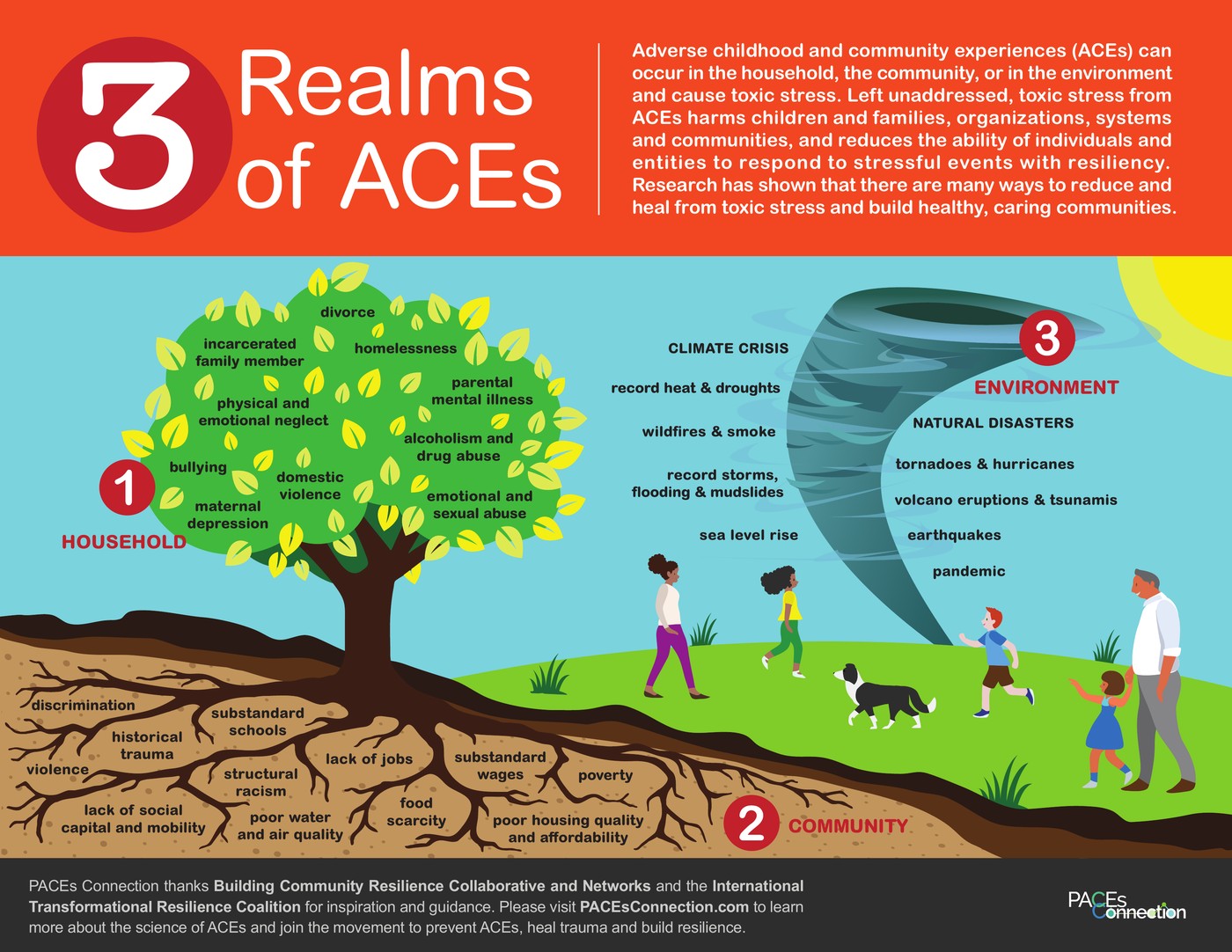
Adverse childhood and community experiences (ACEs) can occur in the household, the community, or in the environment and cause toxic stress. Left unaddressed, toxic stress from ACEs harms children and families, organizations, systems and communities, and reduces the ability of individuals and entities to respond to stressful events with resiliency. Research has shown that there are many ways to reduce and heal from toxic stress and build healthy, caring communities.
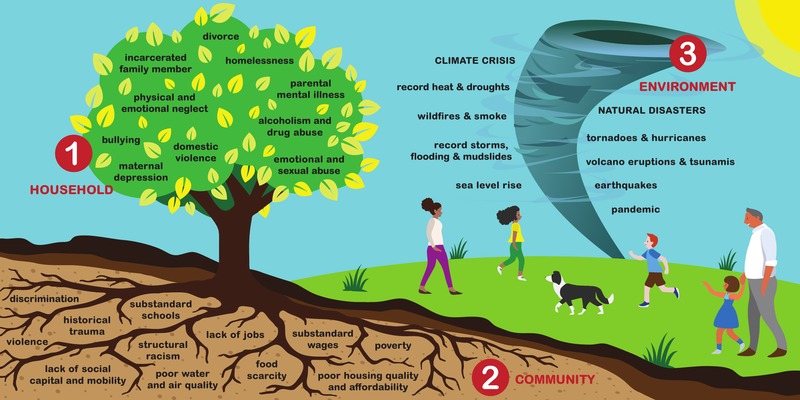
1. Household
Divorce
Incarcerated family member
Homelessness
Physical and emotional neglect
Parental mental illness
Alcoholism and drug abuse
Bullying
Domestic violence
Emotional and sexual abuse
Maternal depression
2. Community
Discrimination
Historical trauma
Violence
Lack of social capital and mobility
Substandard schools
Structural racism
Poor water and air quality
Lack of jobs
Food scarcity
Substandard wages
Poverty
Poor housing quality and affordability
3. Environment
Climate crisis
Record heat & droughts
Wildfires & smoke
Record storms, flooding & mudslides
Sea level rise
Natural disasters
Tornadoes & hurricanes
Volcano eruptions & tsunamis
Earthquakes
Pandemic
ACE Study — Five important findings
ACEs are surprisingly common. 64% of the 17,000 in the ACE Study had one of the 10 ACEs; 12 percent had four or more.
There's an unmistakable link between ACEs and adult onset of chronic disease, mental illness, violence and being a victim of violence.
The more types of childhood adversity, the direr the consequences. An ACE score of 4 increases the risk of alcoholism by 700%, attempted suicide by 1200%; it doubles heart disease and lung cancer rates.
ACEs contribute to most of our health problems, including chronic disease, financial and social health issues.
One type of ACE is no more damaging than another. An ACE score of 4 that includes divorce, physical abuse, a family member depressed or in prison has the same statistical outcome as four other types of ACEs. This is why focusing on preventing just one type of trauma and/or coping mechanism isn't working.
The five parts of ACEs science
ACEs are just ONE PART of ACEs science. The five parts of ACEs science:
The ACE Study and other ACE surveys (epidemiology).
How toxic stress from ACEs damages children's brains (neurobiology).
How toxic stress from ACEs affects our short- and long-term health.
How we pass ACEs from parent to child through our genes (epigenetics).
And how resilience research shows our brains are plastic, our bodies can heal.
We're not doomed!
Our brains are plastic. Our bodies want to heal. To reduce stress hormones in our bodies and brains, we can meditate, exercise, sleep and eat well, have safe relationships, live and work in safety, ask for help when we need it.
We can build resilient families. Educating parents about their own ACEs helps them understand their lives and motivates them to become healthy parents to prevent passing their ACEs on to their kids.
For resilient families, we need healthy organizations, healthy systems and healthy communities. The frontier of resilience research lies in creating communities and systems that prevent childhood adversity, stop traumatizing already traumatized people, and build resilience.
Many people, organizations and communities are integrating trauma-informed and resilience-building practices based on ACEs science, including pediatricians, schools, juvenile detention facilities, businesses, social services, people in the faith-based community, health clinics, etc.
PACEs Connection thanks Building Community Resilience Collaborative and Networks and the International Transformational Resilience Coalition for inspiration and guidance.